


From December to February, many winemakers and vineyard workers can be seen armed with pruning shears, bent over between the rows of vines. This is the winter pruning period for the vines.
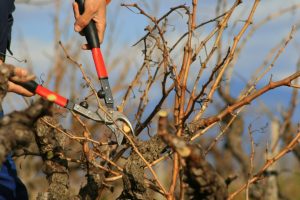
Pruning objectives The vine is a vigorous plant that grows very quickly. The primary objective is to shape and maintain the plant’s form. Pruning regulates growth and determines the future quality and quantity of the grapes produced. Regulating fruit production involves controlling sap production and its distribution throughout the plant. Lastly, the goal is to prevent the elongation and premature aging of the vine stocks.
To achieve this, the winemaker will determine for each vine the number and location of buds that will become fruit-bearing shoots in the next harvest. These future buds are called eyes. Not all buds on the canes are equally fertile. Buds on one-year-old shoots (fruitful buds) are the most fertile. Those on older wood (over a year) will grow randomly. Over the years, this old wood is removed to make way for new shoots that bear clusters. An equilibrium between the plant’s vigor (its energy) and yield (production quantity) must be found.
Pruning is done in winter because the plant is in vegetative rest, meaning it is dormant, and the sap has receded to the roots. This phase is called dormancy. Pruning is done as late as possible before bud burst (bud development) to avoid the risks associated with severe frost.
There are several types of pruning depending on the winemaker’s choices, which are also guided by the vineyard’s environmental context: climate, soil, terrain, and grape variety.
Long Pruning Long pruning involves leaving one or more canes on the vine. It is called long pruning because the winemaker leaves many eyes on each cane, between 6 and 12. This pruning technique is quite demanding and cannot be mechanized. It can be easily seen in Bordeaux or Burgundy vineyards with horizontal trellises.
The most common long pruning method is Guyot.
Single Guyot Single Guyot In this pruning method, only one cane is kept, trained along a horizontal trellis. A spur (2-3 buds) is left on the other side of the trunk, which will produce the cane for the following year.
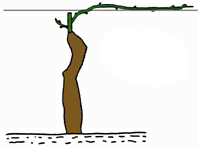
Double Guyot Double Guyot This method follows the same principle but retains two main canes at the ends of the vine trunk. This pruning method is found in Bordeaux and Loire vineyards. Other variations of this pruning style are found in France and worldwide, depending on the production regions.
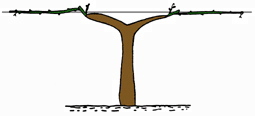
Short Pruning Short pruning leaves only 2 to 3 eyes per cane. There are two main types of short pruning:
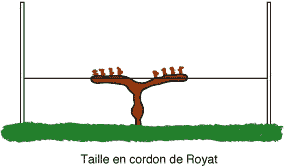
Cordon de Royat Cordon de Royat The permanent T-shaped structure consists of the trunk and two arms, each with 3 or 4 spurs. The spurs are future cane bearers, with 2 or 3 buds each. This pruning method is very common in the Southwest, Cognac, Champagne, and northern Rhône Valley when the topography allows. Its robust permanent structure makes the vine less vulnerable to winter frost and ensures more homogeneity among the grape clusters.
Gobelet Gobelet More common in Mediterranean regions (Languedoc, southern France, Spain, Italy), this pruning method maintains the plant in a crown shape. The goal is to have a non-rectilinear vine with four arched arms shaped like a goblet. This pruning style allows for maximum air circulation and cluster distribution. It also creates a natural leaf canopy to protect the grapes from sunburn in hot production regions.

Pruning represents a significant cost in the annual management of a vineyard because it is one of the last tasks not fully mechanized. However, pruning mechanization is under research and development. For now, this effort can be alleviated by pre-pruning, which can be mechanized in some vineyards, or by close pruning, which requires an adapted vineyard layout and some sacrifices in final quality.
Beyond the technical progress made and anticipated for mechanizing this fundamental step, it is essential to understand that each vine to be pruned must be considered individually. For each one, it is crucial to consider the sap flow and plant morphology to best respect its metabolic activity.
Thus, it is not just a simple snip of the pruning shears!